
'Day One Dictator'
The real danger isn't so much Trump's promise to become a dictator as soon as he wins re-election—it's the army of authoritarian MAGA followers aroused by the whole idea.

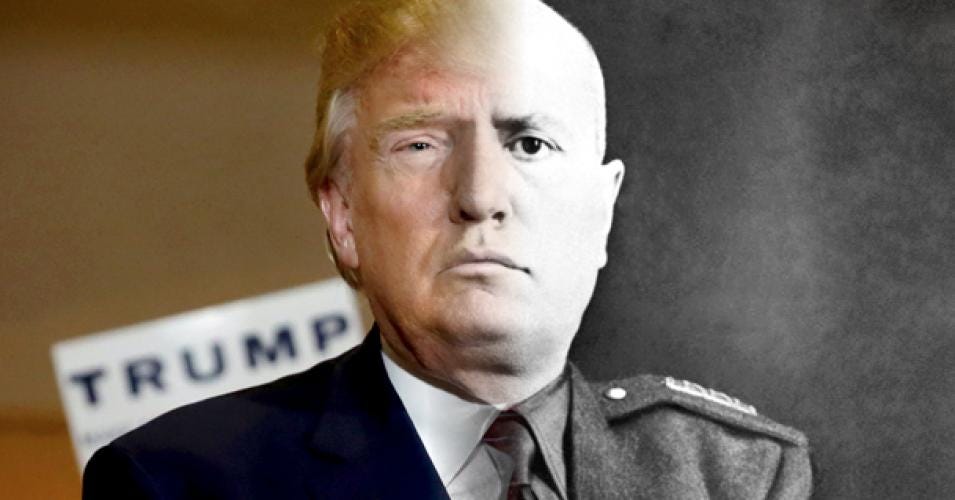
Authoritarianism really is a helluva drug. It’s both addictive and hallucinatory, powerful enough to bring about a range of cognitive dysfunctions, induce personality changes, and ultimately destroy your social and familial relationships. Once you start drinking from the well, it takes either a powerful trauma or personal crisis to break its grip.
Probably its most powerful effect is to make people believe in things for which there is no evidence; so long as it burnishes and rationalizes the authoritarian narrative they embrace, they believe it. Of nearly equal power is its ability to inspire skepticism about even well-established factual reality.
But it also reveals a core truth about authoritarianism: the people who embrace it actively prefer a strongman-style dictatorship to the difficult realities of a democratic society—so long as the strongman is one of them. And their numbers are not small.
We’ve been getting quite a spectacular display, really, of how deeply the authoritarian impulse has embedded itself in the psyche of the American right, thanks to Donald Trump. In the past few weeks, the dictatorial dimensions of his explicitly eliminationist agenda have come into full relief—and even more telling than his own pronouncements has been the enthusiastic response of his “patriotic” MAGA army.
Trump’s right-wing media apologists and normalizers have been trying to push back against the growing media narrative about Trump’s autocratic rhetoric and agenda, papering over the reality everyone except people who drink the Trumpade can see, none more so than Fox News’ Sean Hannity. But when Hannity hosted Trump at a “town hall” event last week, Trump just crumpled up that façade and let the grinning face beneath the mask show.
“Under no circumstances, you are promising America tonight, you would never abuse power as retribution against anybody,” Hannity implored him in the interview. [In fact, Trump last March had vowed to his fans: “I am your retribution.”]
“Except for Day One,” Trump answered. “He’s going crazy. Except for Day One. I want to close the border, and I want to drill, drill, drill.”
He shortly reiterated: “I love this guy. He says you’re not gonna be a dictator, are you. I say, no, no, other than Day One. We’re closing the border, and we’re drilling, drilling. After that I’m not a dictator.”
Hannity, of course, did not point out the obvious problem with this: That even if we take Trump at his word that he would assume dictatorial powers for only a day in order to achieve only two key policy goals—closing the border to immigrants and opening up oil drilling—those two policies would require him to continue to hold dictatorial powers because they are both ongoing matters that can’t be sustained after only a single day.
No, we all know that if Trump declares himself only dictator for a day, that day will last for years. And it won’t restrict itself to two issues. That’s how dictatorships have always worked.
Indeed, it’s clear from examining the details of the Trumpist post-election plans contained in the Project 25 blueprint, Trump’s first-day dictatorship will actually be concerned primarily with gutting the Department of Justice and replacing its personnel with obedient Trump toadies. And that’s just for starters.
Regardless, hosts at Fox News went right back to work normalizing Trump’s remarks, claiming he had been joking—and in fact had defused the concerns about a Trump dictatorship by making it into a joke. The problem with this thesis is that out there in MAGA-land, they don’t think it’s a joke at all. They believe he means it.
You could hear it especially coming from the ranks of the MAGA loyalists who line up outside his campaign rallies. At Durham, New Hampshire, a host for the far-right ultra-MAGA Live From America (LFA) streaming outfit named Jeremy Herrell could be heard cheering the idea of Trump as a “Day One Dictator!” with attendees who responded in kind:
TRUMP FAN: Day One Dictatorship! Right! We gonna drill, baby, drill!
JEREMY HERRELL: Hey, how many people here, now normally I know you probably wouldn’t in America, but considering what they’ve done to this man, how many people here support Day One Dictator?
TF: Day One!
JH: Because you know, because you know who he’s going to be, It’s not it’s not really a dictator. It’s really just giving the people justice for what they deserve, for what they’ve done to us. Not really to him, but to us. I don’t think that his retribution presidency that he’s talking about, I don’t think it’s for him and his family. I really do think it’s for us. What do you think about that?
TF: I 100% agree. And I tell everybody that’s why what is going on him has to happen to him first, because now when he gets back in control, it’s game over! And we as the American people are going to be easier to accept what’s going to happen in the next couple of years because we’ve seen how they’ve come after him.
JH: Yeah.
TF: You know, they can’t say that he’s well, I mean, they are saying that he’s coming after his political opponents, but literally that’s exactly everything they’re accusing this man of doing is literally what has been going on for the last…
JH: That’s why I have no problem with day one dictator. That’s why I have no problem with it.
TF: If a dictator means he’s going to drill, baby, drill? I’ll… Sign me up for that dictatorship anywhere, baby!
On TikTok, a MAGA fan outside a Trump rally in South Carolina explained to an interviewer:
Trump made this country great again. I truly believe Trump made this country great again, and the foundations that this country stood for. Trump made this country great again.
The man called the 2020 epidemic a “Plandemic,” and explained: “We all know COVID, you know, this whole thing was orchestrated, Chinese trying to veto Trump out of office, I’m looking at you. And you know, we’re not stupid.”
As for why he so preferred his smaller Trump pandemic aid check to the larger sum provided by the Biden administration, he replied that it was Trump’s autograph on the checks: “That did it for me!”
An attendee of the New Hampshire rally gushed about what Trump means to her:
He seems to really care. When he’s onstage, his presence of what he’s talking to us, his patriots, he loves us, he cares about what we do, he cares about how sad we are, he cares about the hungry, he cares about the fighting and the wars and all this other stuff. Who else can we vote for but Trump to have a president who stands behind the people of the United States of America, and that’s what we need.
A woman at a Trump rally in Coralville, Iowa, gushed similarly:
Number one, he is a godly man. He is workin’ for God, for darn sure. He really cares about us, he cares about what happens to us, he cares about our country. He didn’t come in there because he wanted the money, he’s got money. He is in there because he is actually working for God, he wants to get us to a good spot. He wants to make America great again. It’s true. And I think he’s going to make it even greater. Because no matter what they do to try to stop him, he is going to come back. Because he is working for God, and God’s on his side.
Not that there has ever been any evidence that Trump is a godly or devout or churchgoing man or even a student of the Bible—the kind of traits that normally lead people to claim that he is “workin’ for God.” Nor has he ever shown any sign of actual concern for the working-class people who flock to his rallies—other than unleashing a pandemic on the population through incompetence and malfeasance, losing 2.9 million jobs in the process, and bouncing the unemployment rate to 6.3% on his watch.
But the hallucinatory power to see things that aren’t there is all part of the authoritarian-personality package. And it’s not just visible among the MAGA crowds, but quite clearly finding a home in the mainstream media as well. The New York Times even ran an op-ed that tried to airbrush Trump’s authoritarianism out of existence, gaslighting readers with patent tripe claiming “he is perceived by many voters — often with good reason — as a pragmatic if unpredictable kind of moderate.”
The piece soft-pedals Trump’s dinners and associations with antisemites and far-right extremists like Kanye West and Nick Fuentes, noting obsequiously that Trump reportedly was “the only living American president who wasn’t descended from slaveholders.” This may be so, but it is probably more relevant that Trump is the only president whose father was arrested at a Ku Klux Klan rally (though there’s no evidence he was a member).
It also trivializes the Jan. 6 insurrection by comparing it to the violence at the summer 2020 anti-police marches, and equivocates that Trump’s fraudulent claims about the 2020 election are somehow comparable to Democrats’ well-grounded concerns in 2016 over winning the popular vote but not the Electoral College. And he voices sympathy with “voters who remain angry that Mr. Trump’s opponents, including elected officials, challenged the legitimacy of his presidency even before he first took office,” but obtusely forgets that Republicans in 2008 attacked Barack Obama’s legitimacy on the basis of spurious conspiracy theories about his birth certificate—claims which formed the foundations of Trump’s entire political career.
Now, when most of us hear the term or think about authoritarianism, we usually do so in the context of the leaders throughout history who have headed up authoritarian regimes—everyone from Napoleon to Hitler and Stalin to any number of petty banana republic dictators. But that’s not what actually makes authoritarianism work, or at least it’s not the whole story.
No authoritarian regime has ever existed without a substantial percentage of the population it rules actively supporting and preferring it. They all have large armies of followers who sustain them in power. So to understand authoritarianism, it’s essential first to understand the distinctive personality types that are attracted to it and support it.
Grappling with the human dimensions of this phenomenon has occupied a number of psychologists, sociologists, and psychiatrists since World War II. At times it has been analyzed as totalitarianism or totalism; in more recent years, authoritarianism has become the preferred term in part because it has a broader sweep. Some of the more recent work by psychologist Robert Altemeyer of the University of Ontario and American political scientists Marc Hetherington and Jonathan Weiler has been especially useful. As their studies have explored, most people have some level of authoritarian tendencies, but these are often leveled out by such factors as personal empathy and critical thinking skills, which tend to lead to a less black-and-white view of the world.
Nor is authoritarianism relegated just to the right side of the political aisle. There are also left-wing authoritarians, as any survivor of Stalinist Russia can attest. Theirs is a variation wherein the desired utopian rule becomes the objective.
However, we are currently awash in a flood tide of right-wing authoritarianism that has fully reached mainstream conservatism and overwhelmed it—the Trump presidency being only the most obvious and powerful manifestation of it. However, this authoritarianism began infecting the Republican Party long before Trump ascended to the party’s nomination; it will maintain its toxic gravitational pull on the nation’s politics long after he departs the scene. And the main factor enabling this authoritarian toxicity all along has been conspiracism.
How could supposedly freedom-loving Americans subscribe to an authoritarian worldview? Psychologists have established that most people have some authoritarian tendencies, but these are balanced by such factors as personal empathy and critical thinking skills. In some personalities, however, a combination of factors such as strict or impersonal upbringing, personal trauma, or a harsh rearing environment can produce people who are attracted to the idea of a world in which strong authorities produce order and stability, often through iron imposition of law and order.
Are right-wing authoritarians born or made? Probably a combination of both, though it’s clear that people’s authoritarian tendencies increase the more fearful they are. Identifying a threat and forming a focus on it are essential to shaping these personalities. Some are wired this way from birth. Early theories on authoritarian personalities, now largely discredited, argued for a Freudian model in which harsh rearing environments and personal traumas produced people inclined to insist on a world in which strong authorities produce order and peace.
Most analysis today finds that it usually depends on circumstances. Because it is innate to human personalities, it can remain latent during periods when people do not perceive a threat and increase when they do. Authoritarianism significantly rose in the United States after 9/11. Periods of intense social change also can produce authoritarian backlash, as such changes are often perceived by some personalities as a kind of threat. This is why civil rights advances, such as Black Lives Matter, have so often been perceived as an attack on whites. It’s why white nationalists argue that multiculturalism is a genocidal assault on the white race.
Right-wing authoritarian (RWA) personalities are built around three behavioral and attitudinal clusters, which are closely related groups of human psychology that essentially shape our worldviews.
Authoritarian submission. This is the eager adherence to edicts, rulings, and opinions of the authorities and leaders who are deemed legitimate, built around the belief that a civil, ordered, and secure society requires such submission.
Authoritarian aggression. This is the physical, verbal, and social aggression displayed toward anyone or any trend that runs counter to those authorities or, in the case of leadership, is deemed illegitimate.
Conventionalism. The adamant embrace of what is perceived as the social norm and the “real” national identity and the belief that oneself reflects that “real” identity.
These three clusters interact in myriad ways and produce a long list of identifiable traits. The psychologist Robert Altemeyer of the University of Manitoba, one of the world’s leading experts in this personality research, has compiled a list of authoritarian personality traits that help explain the motivations of Donald Trump’s supporters. Not every authoritarian exhibits every trait, of course; conversely, everyone shares these traits, but not to the high degree of the authoritarian personality:
Such people are highly ethnocentric, inclined to see the world as their in-group versus everyone else.
They are highly fearful of a dangerous world.
They are highly self-righteous.
They are aggressive.
They are highly prejudiced against racial and ethnic majorities, non-heterosexuals, and women in general.
Their beliefs are a mass of contradictions dependent on compartmentalized thinking.
They reason poorly, and they are prone to projection.
They are highly dogmatic.
They are dependent on social reinforcement of their beliefs.
Because they severely limit their exposure to different people and ideas, they vastly overestimate the extent to which other people agree with them.
They are prone to conspiracist thinking and a gullibility about “alternative facts.”
Authoritarianism as a worldview always creates a certain kind of cognitive dissonance, a feeling of unreality, because it runs smack into the complex nature of the modern world while imposing abstract boundaries and rules. The authoritarian worldview attempts to impose its simplified, black-and-white explanation of reality onto a factual reality that contradicts and undermines it at every turn.
People with authoritarian personalities willingly slip into the alternative universe created by their distorted, if not deranged, epistemology because it helps soothe this dissonance, allowing its occupants to glide over inconvenient facts because they participate in a larger “truth.” This bubble, as a creation of right-wing authoritarians, has always played a key role: a refuge for people who reject factual reality, a place where they can convene and reassure one another in the facticity of their fabricated version of how the world works.
So conspiracism is especially appealing to people with these personality traits—the people who tell pollsters they “don’t recognize their country anymore” and are discomfited and bewildered by the brown faces and strange languages that have been filling up their cultural landscapes in places where they never used to be.
One study found that conspiracy theories seem to be more compelling to “those with low self-worth, especially with regard to their sense of agency in the world at large.” They often long for a 1950s-style America with lawns and cul-de-sacs and are angry that the world no longer works that way. Whereas the mainstream media simply present the world as it is, conspiracy theories offer narratives that explain to them why the country is no longer what they wish it to be, why it has that alien shape. And so in their minds the theories—because they never believe just one conspiracy theory, but rather, an interconnected web of them—come to represent a deeper truth about their world, while repeatedly reinforcing their long-held prejudices, and enable them to ignore the real, factual (and often uncomfortable) nature of the changes the world is undergoing.
Simply put, the assembled narrative provides a clear, self-reinforcing answer to the source of their personal disempowerment. It also has the advantage of telling believers that they are the solo, go-it-alone action heroes in the movies of their own lives.
The deep irony in all this is that the larger psychological and even political effect of conspiracy theories is that they are profoundly disempowering in and of themselves. Conspiracists disconnect from the rest of the world, whom they either hold in paranoid suspicion or contempt. The narrative arc of the conspiracy universe begins with the adrenaline rush of empowerment and ends with isolation, anger, and potentially even violence. You start out thinking you’re smarter than everyone else around you and have an inside edge on them, and end up huddling in a cabin in the back woods with no remaining friends in the world.
There can even be outright cognitive effects, sort of a hardened variation of the old Upton Sinclair adage: “It is difficult to get a man to understand something, when the entire worldview around which his emotional life revolves depends on his not understanding it.” People who are “red-pilled” see themselves as utterly disattached from their physical communities, replacing them with wired-in virtual online communities, fighting a desperate battle with only the help of their fellow conspiracists against truly dark and evil forces. It’s this heroic self-conception that really holds people inside these worlds, but in the real world it rarely, if ever, works out well.
Alex Jones continually refers to his targets as “demonic.” It’s not just a bleak world, it’s one in which people can become overwhelmed with feelings of helplessness and anger in the face of existential evil. So out of this universe proceeds a steady trickle of people who have decided it is time to act—usually out of a desperation fueled by rage over their sense of deep disempowerment, all of it a product of a belief in conspiracy theories.
The violence committed by these domestic terrorists serves the purposes of authoritarians in profound ways, because it ratchets up the levels of fear in society generally, and resorting to the false security of authoritarianism is a common psychological response.
This is where the role played by authoritarian leaders is key. Because rather than ease people’s fears, as a normative democratic leader would do, authoritarians immediately reach for the panic button. Keeping the populace in a fearful state is a cornerstone of their rule. Just ask Donald Trump.
Authoritarian leaders have a personality type quite distinct from their followers. It is called social dominance orientation (SDO), which is essentially a form of narcissism on steroids.
SDOs are far more interested in the personal acquisition of power than are RWAs, who by nature are more inclined to march on someone else’s behalf. They also have different reasoning capacities and are far more calculating and manipulative.
What they have in common, more than anything else, is a shared dismissive view of equality as an important social view. They both believe that inequality is the natural state of the world and that any attempts to tamper with it are doomed to fail and screw everything up. Like Jordan Peterson, the “intellectual dark web” psychologist associated with far-right “traditionalists,” described this in a new foreword for Solzhenitsyn’s Gulag Archipelago:
Inequality is the iron rule, even among animals, with their intense competition for quality living space and reproductive opportunity—even among plants, and cities—even among the stellar lights that dot the cosmos themselves, where a minority of privileged and oppressive heavenly bodies contain the mass of thousands, millions or even billions of average, dispossessed planets. Inequality is the deepest of problems, built into the structure of reality itself, and will not be solved by the presumptuous, ideology-inspired retooling of the rare free, stable and productive democracies of the world.
This simultaneous contempt for attempts to overcome inequality and for the democratic institutions intended to give ordinary people the political power to do so is a thread that runs throughout authoritarian discourse, among both the angry foot soldiers and their narcissistic leaders. They both believe that there is a natural hierarchy of the gifted and the less so. It’s just that SDOs tend to see themselves among the former, while RWAs are more likely to view themselves among the latter but harbor ambitions to rise to that other station, along the lines of the aphorism attributed to Steinbeck: “Socialism never took root in America because the poor see themselves not as an exploited proletariat but as temporarily embarrassed millionaires.”
Given its innate preference for autocratic rule, authoritarianism is also toxic for any kind of democratic society. The MAGA right’s express hostility to democracy (“it’s not a democracy, it’s a constitutional republic!”) and its institutions makes its rise as a political phenomenon a concern not just in the United States, but around the world—especially as conspiracism begets more and more violence.
We also run the very real risk of an era of scripted violence: the phenomenon that occurs when a major cultural figure uses his position and the media to call for violence against a targeted minority group and his fanatical followers carry it out. The kind of violence we saw on Jan. 6.
How does scripted violence work? Analyst Chip Berlet explains:
The potential for violence in a society increases when the mass media carries rhetorical vilification by high profile and respected figures who scapegoat a named “Other.” This dangerous “constitutive rhetoric” can build an actual constituency of persons feeling threatened or displaced. Or to put it another way, when rhetorical fecal matter hits the spinning verbal blades of a bigoted demagogue’s exhortations, bad stuff happens.
The resulting violence can incite a mob, a mass movement, a war, or an individual actor. Individual actors who engage in violence can emerge in three ways. They can be assigned the task of violence by an existing organizational leadership; they can be members or participants in an existing organization, yet decide to act on their own; or they can be unconnected to an existing organization and act on their own. According to the US government definition, a “Lone Wolf” is a person who engages in political violence and is not known by law enforcement agencies to have any current or previous ties to an organization under surveillance as potential lawbreakers. The person committing the violence may expect or even welcome martyrdom, or may plan for a successful escape to carry on being a political soldier in a hoped-for insurgency. Either way, the hope is that “a little spark can cause a prairie fire.” Revolution is seldom the result, but violence and death remains as a legacy.
This plays a key role in violence created by a tide of so-called “conservatives” radicalized online by far-right ideologues and conspiracy theories. Having a figure like Trump both normalizing their extremism and encouraging violence in support of it means that it is being spread throughout American society.
The way this finds expression is with men like “MAGAbomber” Cesar Sayoc, who see themselves as “warriors” in a larger fight against evil itself, which in their view is embodied by liberals and leftists. This is why so many right-wing Trump supporters speak so eagerly of launching a “civil war” against urban liberals, and why so many of them wonder aloud: “When do we get to use the guns? … How many elections are they gonna steal before we kill these people?”
Trump himself indulges in this “warrior” mentality. A 2017 New York Times piece explained Trump’s worldview somewhat nonchalantly in a piece exploring why the president attacked NFL players:
In private, the president and his top aides freely admit that he is engaged in a culture war on behalf of his white, working-class base, a New York billionaire waging war against “politically correct” coastal elites on behalf of his supporters in the South and in the Midwest. He believes the war was foisted upon him by former President Barack Obama and other Democrats—and he is determined to win, current and former aides said.
Trump thus continually justifies the violence inflicted by his supporters, suggesting that the victims have it coming. That’s implicit in his threats to arrest members of the Biden family and administration within days of reascending to power, and his warnings to Biden to “be careful what you wish for.”
But he also unleashes a vicious kind of scapegoating violence with his eliminationist rhetoric, such as his recent rally speech describing immigrants:
They’re poisoning the blood of country. They poison mental institutions and prisons all over the world not just in South America, not just the three or four countries that we think about, but all over the world. They’re coming into our country from Africa, from Asia, all over the world, they’re pouring in to our country, nobody’s even looking at them. They just come in. And the crime is gonna be tremendous, the terrorism going to be.
When observers noticed how closely Trump’s rhetoric echoed that deployed by Adolf Hitler, he defensively explained at his next rally that he had “never read Mein Kampf.” This kind of evasive denial—someone does not need to have read Hitler’s ur-text to understand his ideology and rhetoric, particularly not if you keep a collection of his speeches on your bedstand—is a tell, the kind of “cleverness” that gives his white-nationalist and neo-Nazi defenders extreme joy.
Yet regardless how vile his rhetoric gets, or how deep his legal problems become, Trump’s authoritarian following does not budge. His support among Republican voters remains steady at about 65%—even though an increasing number of those voters believe it’s likely he committed criminal acts. They simply don’t care—or they even like him better for it. That’s how authoritarian personalities think.
This tide of authoritarianism has been unleashed on the American populace by our corporate plutocratic overlords, who clearly have tired of having to put up with the restraints imposed on their august and brilliant selves by the riffraff and their democracy. They may succeed. I only hope I live to see them realize they killed their golden goose.
It’s as if I just read a rather detailed description of the internal narrative arc belonging to my parents and my brother. Days after J6 I wrote to them appealing to their best selves. I revised and revised with love and vulnerability. I simply asked them to say what they believed the reality of J6 was. What I got back haunts me to this day. It ended with the moral equivalent of “go fuck yourself” from my dad. A couple months later I found myself making my own plans to attend his middle brother’s funeral because they had excluded me from their plans. While there I got an earful of Qanon dogma and MAGA “rhetorical fecal matter” from my brother, morning and evening of the graveside service. I came to understand that I was attending more than one funeral.
The connecting tissue seems to be hatred for the rest of us. As we’re seeing more and more, right wingers have no interest in living under the strict rules they want to impose on the rest of us: Moms for Liberty can demand students not be told that gay people exist, while they can have regular multiple threesomes; shoplifters should be summarily shot but when Donald Trump commits fraud “everyone does it.”
I think there’s a uniquely (?) American connection between the authoritarians and the Confederates. Both think they’re the Real Americans, irrespective of what most people in America think or want. (Get into a conversation about the Electoral College and they go full Blood and Soil REAL fast.)