Idaho legislators hoping to simply wish domestic terrorism away are ignoring state's deep history
Let's recall the extensive record of violent far-right extremists operating from the Northwest before Republicans try to conveniently erase them in the law books.

Idaho legislators have come up with a novel way of dealing with violent far-right domestic terrorism: Just redefine it so that they can pretend it no longer exists.
Last week, the Idaho Senate approved a bill (Senate Bill 1220) that would gut the state’s domestic-terrorism law, passed in 1987, by redefining the term to only include activities “that are done in cooperation with any foreign terrorist organization.” It appears likely to pass the House and proceed to Gov. Brad Little’s desk.
This is not just an unusual approach, it’s deeply counterfactual. Terrorism conducted on behalf of a foreign organization has always been defined as international terrorism; such acts committed on behalf of homegrown movements or organizations by citizens is called domestic terrorism. Just ask the FBI.
The proposed law, Newspeak-like, would effectively erase domestic terrorism as a crime in Idaho. Though that hardly means it would cease to exist—particularly in Idaho, which has a long and unpleasant history of hosting violent domestic terrorists. The legislators promoting this bill either have completely forgotten this history or are working to bury its memory—even though the record includes criminal acts committed in just the past few years.
This is convenient for a state Republican Party that has come under the control of a claque of right-wing extremists dominated by recent transplants from California and other states fleeing to what they hope are redder pastures—people with little to no actual sense of the state’s real history, even as they hope to chase out intergenerational natives who know the history all too well for not being “real” Idahoans.
So let’s take a stroll down memory lane and recall some of the domestic terrorists who operated out of Idaho—often exporting their violence to neighboring states—over the past 40 years.
THE ORDER
Nearly all of the domestic terrorism and hate crimes that beset northern Idaho in the 1980s was a byproduct of the presence of the Aryan Nations compound, which set up shop in the Hayden Lake area in the late 1970s when leader Richard Butler moved his Christian Identity church there from southern California.
Their mission, called the “Northwest Imperative,” was to transform the Pacific Northwest (and Idaho in particular) into an all-white homeland. Within a few years, the region was awash in neo-Nazis and other far-right extremists who had moved there to join forces with Butler and his church. Among them was a young man from Arizona, radicalized by the John Birch Society, named Robert Mathews, who bought a rural property near Metaline Falls, Wash. Mathews was a fanatical admirer of the neo-Nazi blueprint for a future race war, William Pierce’s novel The Turner Diaries.
By June 1983, Mathews was in the fore of Butler’s entourage. He served as a security officer for an Aryan Nations rally in Spokane’s Riverside Park, and got into a shouting-and-pointing match with a group of counter-protesters. The next month, Mathews was in the audience listening as Butler hosted that year’s Aryan Congress. The main topic of discussion was the martyr’s death the month before of Gordon Kahl, a 63-year-old Posse Comitatus leader from North Dakota who had killed two lawmen in a February standoff near his family farm, went on the lam for five months, and killed another lawman before dying himself when he was finally cornered in rural Arkansas. The gathering at Hayden Lake featured one expression of outrage over Kahl’s fate after another.
The crowd there heard ex-Klansman Louis Beam, who had led a vigilante Texas army in its harassment of Vietnamese fishermen in 1981, proclaim: “We are at war! We must pledge our blood for the new nation! There’s nothing we won’t do to bring about the new kingdom, the new nation!” Michigan racist leader Bob Miles, in his speech, suggested it was time to fight back. Miles expressed admiration for radical Black Liberation Army members who had committed a Brinks armored-car robbery in 1981: “If we were half the men the leftists were, we’d be hitting armored cars too.”
All these calls for action apparently had their effect on Bob Mathews. Shortly after that 1983 Congress, he began assembling a group of close friends and fellow believers in a spinoff organization he called the White American Bastion. Their ultimate purpose: igniting a civil war that would liberate the “white race.” In late September, he called eight others to his farm and, with the infant daughter of one of the men placed in a circle on the floor of a woodshed, they swore an oath as “Aryan Warriors” that concluded:
“We hereby invoke the blood covenant and declare that we are in a full state of war and will not lay down our weapons until we have driven the enemy into the sea and reclaimed the land which was promised to our fathers of old, and through our blood and His will, becomes the land of our children to be.’’ They called themselves the Bruders Schweigen (Silent Brotherhood), or, at other times, the name William Pierce had given the band in The Turner Diaries: The Order.
On October 26, four men led by Mathews committed a nervous robbery of a Spokane X-rated video shop, making off with a grand total of $396.10. They quickly graduated to more; Mathews robbed a City Bank branch north of Seattle for $25,900 in December; his two right-hand men, Bruce Pierce and Gary Yarbrough, robbed an Idaho truck stop; then the same pair robbed a Spokane bank, creating a distraction by leaving a fake bomb near the video shop they had robbed previously. The trio started to hit their stride when they robbed an armored car at a Seattle Fred Meyer store in March 1984. A month later, they hit another armored car at Seattle’s Northgate Mall, making off this time with $250,000.
Nor was robbery their only means of extralegal fund-raising. Yarbrough, a former Arizona prison inmate, had tried making counterfeit bills using the printing press at Aryan Nations, where he was a security officer. But the phonies were badly made; Pierce was arrested for trying to pass them off in Union Gap, Washington, though he later walked on bail and promptly disappeared. Mathews shortly turned to a more professional counterfeiter named Robert Merki, who (along with his wife) churned out significant numbers of phony bills that were distributed in the Boise area.
The next step in their escalation was assassination. Near the top of the list was a man who had gotten truly under Mathews’ skin: a Denver radio talk-show host named Alan Berg. Not only was Berg Jewish, he also liked to roast his right-wing callers on the air, then cut them off. Among his victims had been Col. Jack Mohr, a speaker Mathews had idolized since his days in the Arizona Sons of Liberty, and David Lane, a member of Mathews’ band.
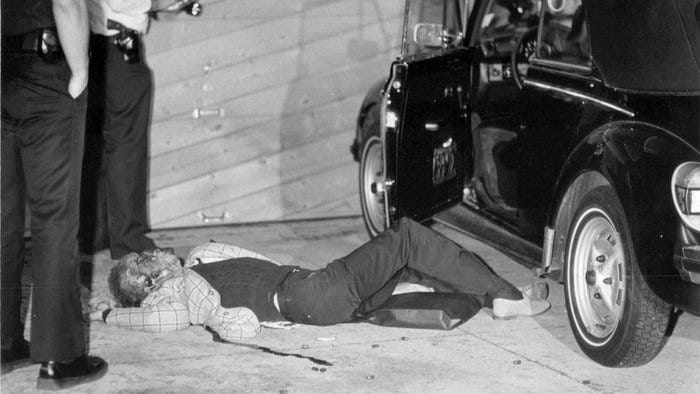
So on a warm June evening, as Berg stepped from his Volkswagen Beetle outside his apartment, a car containing Mathews, Pierce, and David Lane pulled up. Pierce stepped out, pulled out a MAC-10 automatic assault gun and poured a round of .45-caliber slugs into the radio jockey. Berg died instantly, and the killers made a clean getaway. Police were baffled for months by the assassination.
Mathews decided it was time to make a hit for big money. On July 12, with a group of 12 men, The Order staged a mid-highway robbery of a Brinks armored car outside the northern California town of Ukiah, where they made off with $3.8 million. It remains the largest overland bank robbery in American history.
At about the same time, though, the scheme began to unravel for Mathews. His Philadelphia contact, Thomas Martinez, was caught passing phony bills; faced with jail, he soon started spilling his guts to FBI officials about Mathews’ activities. Simultaneously, a gun left behind at the Ukiah robbery put the FBI on the trail of Pierce and Yarbrough. They nearly nabbed Yarbrough in an ambush at his Sandpoint home in mid-October, but Yarbrough escaped. Pierce hid out in Nevada. Mathews and the rest of the group stayed mobile.
Tom Martinez flew out to Portland in late November to meet with Mathews, who had found a “safe house” to rent in a nearby suburb. By then, the FBI had converted Martinez into an informant, and when he met with the Order leaders at a Portland motel November 24, federal agents swooped in on the gang. They captured Yarbrough, but Mathews made a mad dash to escape, wounding one agent in the leg and suffering a hand wound himself in the process.
Two weeks later, an anonymous informant spilled the secret of Mathews’ whereabouts to the FBI. He, Ronald Duey and the Merkis were hiding on Whidbey Island, a narrow strip of land north of Seattle in the Puget Sound, accessible by a land bridge from its northern end and by ferry from the south. Again, the FBI swooped, successfully capturing the Merkis and Duey the morning of Friday, December 7.
Bob Mathews, though, refused to leave the wooded cabin where he was holed up, and he stayed there for the next day, while the FBI tried to negotiate. When agents tried to storm the cabin Saturday afternoon, he repelled them with a barrage of machine-gun fire. Finally, as night approached, the agents lobbed a flare into the cabin to provide them with light.
The flare set the building on fire. Still Mathews did not come out. The fire was punctuated by explosions as his weapons cache caught flame. The building burned to the ground. The next day, sifting through the ashes, they found Bob Mathews’ charred body, curled up inside the bathtub.
Over the course of the next year, twenty-four people would be indicted for The Order’s crimes. Twelve pleaded guilty; ten were convicted in December 1985 by a Seattle jury, while another, Richard Scutari, pleaded guilty after finally being apprehended in 1986. The last, David Tate, was never tried; instead, he was convicted in the 1985 slaying of a Missouri state trooper and was given a life sentence. The major players—Bruce Pierce, Gary Yarbrough and David Lane—all eventually died in prison. A few months after the trial concluded, the Aryan Nations’ security chief, Elden “Bud” Cutler, was convicted of hiring a hit man (who actually was an undercover FBI agent) to behead Tom Martinez; he was given a twelve-year sentence.
THE ORDER II
Bob Mathews and The Order weren’t the only people from the radical right stirring up trouble. Beginning in 1980, a series of incidents underscored the violence brewing in northern Idaho:
Some black families in Coeur d’Alene started receiving notes in the mail saying: “Nigger, don’t let the sun set on your head in the Aryan Nations.”
A Jewish restaurateur’s Hayden Lake steakhouse was spray-painted with swastikas and the words ``Jew swine.’’ He promptly put the restaurant up for sale, and a year later was out of business altogether. Swastikas also started popping up as graffiti around the Coeur d’Alene area, notably on a Baptist Church and a printing business.
A Coeur d’Alene woman whose son was of mixed racial heritage suffered a barrage of hate-filled threats from a neighbor who attended Aryan Nations meetings. Among them: a poster mailed to her warning that “race traitors, those guilty of fratinizing [sic] socially or sexually with blacks, now stand warned that their identities are being catalogued ... Miscegnation is race treason, race treason is a capitol offence; it will be punished by death.’’ When the boy encountered the man in the neighborhood one day, his tormentor—a well-known associated of Butler’s named Keith Gilbert—asked: “How art thou today? Thou shalt not live very long.”
A group of young white males associated with the Aryan Nations physically and verbally attacked a young mixed-race couple outside of a Coeur d’Alene bowling alley.
Crosses were burned on the lawns of two different Coeur d’Alene families in 1982 and 1983. In the latter case, the victims were an all-white family living in a mixed-race neighborhood, mistakenly targeted, police say.
The trouble reached a boiling point in the community. Trying to counter the venom bubbling out of the Aryan Nations, a group of Coeur d’Alene ministers put together a proclamation denouncing racism and anti-Semitism in late 1980. By the next year, combining the efforts of newly hired Kootenai County Undersheriff Larry Broadbent, the Rev. Rick Morse from the ministers’ group, community activist Dina Tanners, and several others, the Kootenai County Human Rights Task Force was under way, forming a community front that included business, church and government leaders. The group’s efforts were instrumental two years later in passage by the Idaho Legislature of a law making malicious harassment—for racial, ethnic or religious reasons—a felony. (This is the law that the current Legislature is considering overturning.)
Father Bill Wassmuth, pastor of Coeur d’Alene’s St. Pius X Catholic Church, took the reins of the KCHRTF in late 1984, incorporating it in 1985 as a non-profit entity. The group immediately raised its profile, drawing in especially the participation of the Chamber of Commerce and local business leaders. It began pushing for passage of a bill outlawing paramilitary groups in the state.
It wasn’t long before the objects of their campaign struck back. On September 15, 1986, a pipe bomb was left behind the door to a back room of Wassmuth’s Coeur d’Alene home while he was asleep. No one was injured, but the blast blew out a chunk of the house, and would have been lethal had anyone been in the room. (At his trial later, the man who threw the bomb admitted that the original plan was to throw it in Wassmuth’s bedroom, but he changed his mind at the last moment.)
Two weeks later, three other bombs went off: at the Coeur d’Alene Federal Building, on the roof of a couple of retail stores, and in a restaurant parking lot; a fourth bomb, unexploded, was found on the roof of a building kitty-corner from the Federal Building. An anonymous woman phoned offices at North Idaho College, where a human-rights rally had been held the week before, and tried to pin the blame on black revolutionaries: “Three pipe bombs have gone off already. You wanted a nigger uprising, and now you’ve got one, honey.”
Richard Butler similarly tried to pin the blame for the bombings on the Anti-Defamation League, but within a few days, the chickens came home to roost in the Aryan Nations’ own back yard. Police raided the home of Butler’s new security chief, David Dorr, and found explosives and a pile of other evidence linking him and three others to the crimes. Two of them, a husband-and-wife team, also were discovered to be operating a counterfeiting scheme.
They called themselves the Bruders Schweigen Strike Force II, or The Order II. The counterfeiting couple pleaded guilty that winter after two days of a jury trial. Dorr was convicted in the spring of conspiracy, firearms charges, and counterfeiting after the fourth figure, former chief henchman Robert Pires, turned state’s evidence on all involved. Worse, Pires told authorities he and Dorr had killed another Aryan Nations follower—a onetime pal of Pires’s—when they came to feel he could not longer be trusted. Pires pleaded guilty to first-degree murder, then was the chief witness against Dorr, who got a 40-year sentence for the combined crimes.
THE NEIGHBOURS GANG
In 1990, several members of the Aryan Nations organization from Hayden Lake were arrested and charged with plotting to kill dozens, if not hundreds, of Neighbours patrons. They had traveled to Seattle intent on reigniting The Order’s campaign of domestic terrorism against their perceived enemies: Jews, African Americans, and gay men and lesbians. Once again, they turned out to have an informant in their midst, a man named Rico Valentino.
Their first target, they had decided, would be Neighbours, at the time one of the largest gay clubs in the city’s Capitol Hill area. They tested a pipe bomb in the Idaho woods and were impressed by its explosive power. Had it gone off in the middle of a crowded room—Neighbours was then known to pack in several hundred on weekend nights—the place “would resemble a meat grinder,” according to their own assessment. They worked out a “kill zone” strategy in which the explosives would be placed inside the bar, with other bombs placed outside it. Their plan was to call the bar, warn that a bomb was about to go off, and then set off the secondary charges as the disco cleared out, maximizing the number of fatalities.
On May 12, 1990, a trio of “Aryans”—Valentino, Robert John Winslow and Stephen E. Nelson, the Aryan Nations security chief—drove together to Seattle in a van stocked with pipe-bomb parts, a .12-gauge shotgun, a .38-caliber revolver, a stun gun, knives and a pile of hate literature. But as they got out of the van to check into a motel near the Seattle airport, the FBI moved in and arrested the men, except for Valentino, who had orchestrated the arrests. In Hayden Lake, they arrested another member of the group at his home: Procter James Baker, 58, an Aryan Nations regular.
Winslow, Nelson and Baker went to jail, while Valentino went into protective hiding to await the trial as the chief witness in the case. In October, after 10 days of testimony, a Boise jury convicted all three on conspiracy, bomb-possession and firearms charges. They were sentenced to a range of prison terms, with Nelson getting the longest, a 25-year sentence. Baker served two years of his 10-year term before being released on probation.
THE PHINEAS PRIESTHOOD
In the fall of 1995, reporter Bill Morlin of the Spokane Spokesman-Review was invited by a secretive militia group that offered to let him and a photographer tag along on a training session in the northern Idaho woods outside of Sandpoint. Morlin and S-R photographer Dan McComb were both blindfolded by their contacts and then taken to the training area, a remote spot deep in the Panhandle forest somewhere. When the blindfolds were removed, Morlin and McComb found themselves surrounded by a group of armed men with ski masks, who proceeded to conduct military-style exercises and plunk at silhouette targets in the shape of Hillary Clinton and federal agents. The photos of the masked gunman became an iconic depiction of the militia movement.
On the same day in December that the encounter was published, Morlin also ran an interview in the Spokesman-Review with a Sandpoint-area man who had made some minor waves with his own arsenal. Charles Barbee, who operated a Ponderay body shop, and a traveling companion named Robert Berry had been pulled over in May in western Washington, near Longview, with a large arsenal: guns, silencers, night-vision goggles, stolen license plates, a high-tech global listening device, and a wealth of ammunition. The pair refused to identify themselves and stayed in jail for a month before being released eventually after federal officials decided not to file charges. Their story intrigued Morlin, who called up Barbee and asked for an interview; Barbee agreed, saying he’d “already been compromised” by the arrest.
Barbee, it turned out, was a regular at Dave Barley’s America’s Promise Ministries church in Sandpoint, having become an adherent of Christian Identity while he was still an AT&T employee in Florida. He told Morlin he was building an arsenal to help erect a defense against the New World Order: “We have to be ready to conduct guerrilla warfare. That’s how it will be won,” said. “If there’s another Ruby Ridge or Waco, we’re not going to tolerate it again. If the federal government sends in their armies to put women and children to death again, we will respond and put as many federal agents to death as possible.”
Then, on April 1, 1996, a bomb went off at the Spokesman-Review’s Spokane Valley plant, blowing out doors and windows but not seriously injuring anyone. Officers were still trying to respond to the call about that attack when they got word of a bank robbery taking place several blocks away.
The two men wore ski masks; one clacked a round into the shotgun as they entered the bank, while the other held up a handgun and announced that this was a stickup. But these weren’t ordinary bank robbers. They had a message they wanted to send, too.
“Tell the cops to free the people of Justus or we’ll be back,” one yelled, as they herded the bank’s employees into a corner and started grabbing cash out of tellers’ drawers. “Justus” was the name the Montana Freemen—at the time in the midst of an 8-day armed standoff with the FBI in Jordan, Montana—had dubbed their insular community.
As the robbery progressed, they shouted more slogans: “Tell your government and its people not to mess with the Freemen!” “It’s free the people in Justus!” “Justice for the people in Justus!”
Then they shouted at everyone to get out of the bank, and the employees quickly complied. One of the men set a pipe bomb atop the head teller’s counter. As the pair ran out of the bank and into a waiting white-and-maroon Chevy van, the bomb went off, blowing a hole in the bank’s ceiling and ripping apart six teller’s stations.
By the time policemen made it to the bank, the robbers were long gone. Investigators found the getaway van about two hours later, parked in the lot outside a Valley home-and-garden store. Inside, there was a jar filled with gasoline, which also had been splashed around the van’s interior. The jar had been intended to detonate, setting the van on fire and destroying its contents. Instead, federal agents and policemen were able to comb the van for clues; they came up with some important pieces of evidence, including fingerprints and “items of interest.”
The most revealing item, though, had been left intentionally by the robbers. At both the newspaper plant and the bank, near where the bombs went off, they had left copies of the same two-page note sealed in plastic.
It was typed, a two-page rendition of Bible verse -- mostly Jeremiah 51, and a portion quoting Revelation 18 -- apparently intended to announce the coming fall of “Babylon.” Some of the language was peculiar: it referred to “Yahweh” where most Bibles refer to “the Lord,” and changed “man” to “Adam-man.” The passages attacked the immorality of secular society, and ended with a warning apparently directed at bankers: “Flee you usurer from the face of our land, and all that would not that the Master should reign over them, for the end of Babylon is come. Praise Yahweh!”
Judging from the language, it seemed clear the note’s authors were believers in Christian Identity, evident sympathizers of the men in Jordan whose standoff was then only a week old. And the symbol at the bottom of the second page clarified the picture even further. It was a combination of a P and a cross: the logo of the Phineas Priesthood.
The Priesthood appears largely to have been a concoction of a Virginia-based white supremacist and Identity follower named Richard Kelly Hoskins, whose 1990 book Vigilantes of Christendom the seminal inspiration for the sect. Often sold at “Patriot” gatherings, it is a blueprint for the group’s violent agenda, one which recommends that true believers should engage in a variety of violent terrorist crimes—murder, assassination, robbery, physical intimidation—in the manner of The Order.
Another bomb went off again in Spokane, just a little more than a hundred days after the first explosion: on July 12. It was a duplicate of the first crime: set off a pipe bomb, then rob a bank. In fact, it was even the same bank. But the initial bomb went off at a new target this time, one nearly as logical as the newspaper: the Planned Parenthood clinic out in the Spokane Valley. The clinic was closed at the time and no one was injured, but the damage was extensive.
As police responded, the men went back to the same U.S. Bank on East Sprague Street, just a few miles away, and robbed it again. This time, three men with masks and ponchos walked in with automatic weapons raised and demanded money. One of them carried what appeared to be a propane tank with some wires rigged to its top, perhaps a large bomb, and set it down on the floor while the other two collected cash.
Bank employees knew the drill. They kept their hands up and handed over the money. The bandits shortly emerged from the bank, cool as cucumbers, with the propane tank-bomb and jumped into the car. One witness saw a second car pull up behind the van and follow it away down the arterial, its driver speaking into a cellular phone. The van was found later, abandoned this time in the parking garage of a mall. Again, it was loaded with a device that appeared to be meant to detonate and destroy the van, but which the Spokane bomb squad, thanks to a robot, soon found was not functioning. When police moved inside, they found the other propane device the men had carried into the bank as well.
The tables were about to turn. By September, the $130,000 in reward money had done its work: two informers had contacted the FBI, eager to collect. One of them had been recruited by the Phineas Priests, who told him that banks were “temples of Satan” and that they had come close to killing a guard in the April Fool’s Day robbery. A second informer contacted them and corroborated the first man’s information. The main informer continued to meet with the gang even after he had officially become a snitch.
The suspects: Charles Barbee, the man Bill Morlin had interviewed in October, and his traveling buddy, Robert Berry, as well as a third man, Jay Merrell, who fit the description of the white-bearded man. All three had met at Dave Barley’s Identity church in Sandpoint. Two undercover agents, following through on the tip, bought a used 1991 Chevy Suburban from Barbee and discovered that it had bulletproof lead in the doors and remotely opened machine-gun trapdoors in the rear panel.
In his meetings with the men, the informer learned they were planning their next bank hit for October 8. This time, federal agents would be ready for them.
When the trio left their homes early that Tuesday, and drove out of Sandpoint in two Chevy Suburbans, they were already being trailed on the highway to Spokane and being observed from a surveillance airplane. This time, though, they drove through Spokane and kept going west on Interstate 90. At Ellensburg, they headed south toward Yakima and then on toward Portland, Oregon. A stolen Ford Aerostar joined them in Hood River, about fifty miles east of the metropolis. They moved a little closer to town, setting up a center of operations at a Troutdale truck stop.
By then, a procession of nearly fifty FBI agents had joined in the surveillance, including a change of airplanes. They watched the men drive their three vehicles back and forth into Portland, where they cased a U.S. Bank branch in the southeast corner of the city. They pulled in and out of driveways in an attempt to avoid being observed. Finally, ready to make their move, all three men drove in the Aerostar to the bank.
The FBI was one step ahead of them. They hastily phoned the bank’s manager while the men were en route and told them the bank was about to be robbed. They instructed the bankers to lock their doors and for all employees to get down on the floor. Everyone hastily complied.
When the three men pulled up and walked up to the bank, masks on and guns raised, they found the doors locked. Confused and surprised, they jumped back in the van and sped away. Back at the truck stop, two jumped out and climbed into the Suburbans, and the three vehicles sped off up the freeway together.
They finally pulled over in the town of Union Gap, just south of Yakima, to gas up at a convenience store. Two got out and went into the store, while the third pulled around to the side to use the restroom. They’d been drinking.
Suddenly, the place was filled with federal agents, running up and down the aisles and throwing the suspects to the ground. They ran, guns raised, into the walk-in cooler. Some of the customers thought it was an armed robbery. Outside, another agent used his gun butt to smash the driver’s side window of one of the Suburbans. Soon, all three men were on the ground in handcuffs. FBI jackets started to swarm the gas station, and the startled customers finally breathed a sigh of relief. Obviously, this was a bust.
Agents also swooped onto the three men’s property, finding a large cache of guns, ammunition, bomb-making supplies, and other weapons, as well as computers, ballistic shields of the type used by riot police and a key-making kit. There were detonators in Jay Merrell’s house. And amid a large cache of guns at Robert Berry’s house were seven Bibles.
Merrell, it seemed, like Barbee had come to Sandpoint in large part because of Barley’s America’s Promise church. He had been a featured speaker at church gatherings on a couple of occasions, testifying of his hatred for the government, and had written for the Identity newspaper, Jubilee. A native of Delaware County, Pennsylvania, where he graduated from high school in 1963. He joined the Navy and became an engineer on nuclear submarines for the next twelve years, before he left to go to work as an engineer at the Peach Bottom Nuclear Plant in Delta, Pennsylvania. He moved around to different jobs in the nuclear industry, working for plants in Ohio, Florida, Texas and even in Brazil, ultimately winding up with the Bechtel Corp., where he helped construct the Palo Verde nuclear plant near Phoenix.
It was while he was living there that Merrell encountered Dave Barley’s church, and he eventually became a regular member. Then, Merrell summarily quit his career as a nuclear engineer and moved up to property he had purchased near Snowflake, Arizona. He became involved with the Arizona Patriots, Robert Mathews’ old gang of anti-Semites who partook in paramilitary activities at night in the desert. Then, when Barley packed his bags and removed from Phoenix to Sandpoint in 1989, Merrell followed shortly thereafter.
Barbee, Merrell and Berry went on trial in March 1997, but a single juror who had told his colleagues he would never find the men guilty eventually forced a mistrial. A new trial began in July, with the prosecution more careful during jury-selection process to screen for potential believers in Patriot ideology. So it was perhaps not surprising that this time around, the jury voted unanimously to convict the trio of eight counts of robbery and bomb-making each: “After awhile, it was clear that the (government’s) evidence was overwhelming,” said one juror. “There were just too many coincidences.” All three men were sentenced to life terms.

THE BSN GANG
The self-described “death squad” of neo-Nazi ex-Marines (plus a porn actor) who had moved from the East Coast to Idaho had a plan: They would take their high-powered rifles to power substations around the region and target transformers in order to render the stations nonfunctional. They also planned to collect the makings for bombs, then use them to blow up other substations—all in order to “take down the entire regional or coastal power grid and cause chaos for the country.” The power failures, moreover, were designed to provide cover for their primary intent: conducting assassinations of “leftists” and robbing banks. The FBI, however, arrested them before they could carry it out.
The terrorist gang—who called themselves “BSN,” an acronym with a meaning that has not been explained by prosecutors—comprised a former porn film actor, two veterans of the U.S. Marine Corps, a currently serving Marine, an Indiana police officer, and an enlisted National Guardsman—moved to the Boise area in early 2020 and began setting up operations there. They were arrested in late October of that year, originally charged with a gun-running scheme before their deeper scheme had been accidentally exposed by antifascists who uncovered the Indiana cop’s deep neo-Nazi background.
But once investigators began sifting through the evidence, they realized the men were plotting much, much more. Three of the men—Justin Hermanson, 21, who used the code name “Sandman”; Liam Collins, 21, aka “Disciple”; and Jordan Duncan, 25, aka “Soldier”—had met while serving in the Marines at Camp Lejeune, North Carolina, while a fourth—Joseph Maurino, aka “Bishop”—was a National Guardsman in New Jersey. The fifth—Paul Kryscuk, 35, whose nom de plume was “Deacon”—was a porn actor (under the stage name “Pauly Harker”) who had lived most of his life on Long Island, New York. He met the other men online in the now-defunct neo-Nazi message board Iron March, though they all identified as members of the larger neo-Nazi terrorist organization Atomwaffen Division.
In 2017, when Iron March was still active, the men had discussed among themselves how to create “a modern day SS,” as one of them put it, referencing the Nazi paramilitary organization Schutzstaffel, the indictment says. Kryscuk outlined the group’s long-range plan then:
"First order of business is knocking down The System, mounting it and smashing it’s face until it has been beaten past the point of death … eventually we will have to bring the rifles out and go to work.”
“Second order of business ... is the seizing of territory and the Balkanization of North America. Buying property in remote areas that are already predominantly white and right leaning, networking with locals, training, farming, and stockpiling.”
“Start buying property now in the types of regions mentioned above and get to work on building your own group … As time goes on in this conflict, we will expand our territories and slowly take back the land that is rightfully ours ... As we build our forces and our numbers, we will move into the urban areas and clear them out. This will be a ground war very reminiscent of Iraq as we will essentially be facing an insurgent force made up of criminals and gang members.”
Kryscuk bought a home in the Boise area in February 2020 and moved there, and Duncan and Collins gradually followed suit. Hermanson—who was stationed at Camp Lejeune in North Carolina and remains an active member of the Marine Corps—joined them in July for a training exercise in the Idaho desert. The participants compiled a video of the live footage from that training showing Kryscuk and another person firing a variety of rifles. At the end, the four men—all outfitted in Atomwaffen masks—are seen giving the Nazi salute beneath a Sonnenrad, an occult Nazi symbol. The final frame reads: “Come home white man.”
Investigators found an abundance of evidence to charge them with plotting to attack the power grid in the region. According to the superseding federal indictment, the five men made plans to use their assault-style rifles to target transformers at power substations in Idaho and nearby states. The men also had a plan to target power transformers using homemade thermite, concocted from Tannerite, which is an explosive available to the public as a target for gun owners. Their plan was to collect enough of the target explosive units to manufacture the thermite, which burns at such a high temperature that it will destroy metal transformers.
Hermanson, the indictment says, told a co-conspirator that if the group was successful in blowing up a power substation, “it would take down the entire regional or coastal power grid and cause chaos for the country.” Just before their late-October arrest, Collins, Kryscuk, and Duncan discussed plans to take out a power grid.
Joining them in the discussions was Joseph Zacharek, who had been a member of the BSN gang since its formation online in 2017 under the moniker “Dealer,” according to testimony by NCIS Special Agent Chris Little. In his Iron March bio, Zacharek had described an interest “in (National Socialist) economics as a way of throwing off the chains of usury and Jewish owned banking” and his disgust with “the vile ‘culture’ of the African.” He went by the nom de plume "Panzerleiter."
Zacharek was hired by the Lafayette Police Department (LPD) in Indiana as a probationary recruit in June 2020. An LPD release at the time described him as a former Penn State student originally from Edwards, New York, who served three years as a tank crewman in the U.S. Army. “He visited Lafayette and fell in love with the community,” the LPD release said.
According to Little, Zacharek was part of a BSN gang discussion in October 2020 about how to successfully attack a power grid, and described a California incident—in which a group of unknown men used rifles to shoot up a transmission station, forcing Pacific Gas & Electric to resort to emergency measures to keep the grid operating. He told them how the men used flashlights to communicate. Afterwards, they critiqued the California operation and discussed ways to make such an attack more successful in disrupting the grid.
Then, on Oct. 16, Zacharek was doxxed by an antifascist researcher who had obtained the Iron March data and connected him to the “Panzerleiter” account, pointing both to his bio and to his disturbing comments, including: “It wasn’t until I started working as an EMT in the inner city that I openly questioned the view that all races are equal.”
Within 24 hours, LPD had announced he was fired. Chief Pat Flannelly was angry and frustrated: “I know the question everyone will have is, how does something like this get missed in a background investigation,” he said. “How is it possible and how do we prevent this from ever happening again?”
In a panic, Zacharek had a text conversation with Duncan. “Mr. Duncan appeared to be encouraging him to get to Boise, and that’s what Mr. Duncan understood the plan to be,” Little testified. “And it—from being able to communicate with Mr. Zacharek, that stressed him out. He became scared and concerned at that point of being—because of being publicly outed and what that meant within the group.
“He was afraid that the group would think he had talked or given information to law enforcement, and he feared retribution,” Little clarified.
What none of them knew was that the original indictment on the weapons charge had already been issued by a grand jury on Oct. 12. The men shocked when they were arrested on Oct. 20. Investigators found Zacharek at his parents’ home in upstate New York. He immediately began cooperating.
Prosecutors say the purpose of the gun-running scheme was “to regularly and repetitively manufacture and transport firearms and firearm parts, to include suppressors, in a manner that the government would not know the recipients had them, for criminal purposes”—namely “in furtherance of a civil disorder.”
The “civil disorder” included attacking the Black Lives Matter movement, including its leadership. Founder Alicia Garza reported in a tweet that the FBI had informed her that her name had appeared on a list of targets found in one of the men’s homes in Boise.
The neo-Nazi gang had twice conducted surveillance on Black Lives Matter events in Boise: First, on July 21, at a rally on the campus of Boise State University, Kryscuk was observed within visual range of the event, first sitting in a parked vehicle and then driving around the gathering slowly.
Then, on Aug. 18, Kryscuk was observed lurking in the vicinity of a Black Lives Matter rally/protest at a park in downtown Boise. Kryscuk and Duncan discussed in a text chat how things would go down after the BSN attacked Black Lives Matter marchers as they envisioned.
“How the BSNs finna be pulling up to chipotle after hitting legs," Duncan asked.
"Death squad," Kryscuk answered, adding: “Assassins creed hoodies and suppressed 22 pistols.”
"People freaking tf out," Duncan replied.
"About what," Kryscuk asked.
"'The end of democracy’," Duncan wrote.
"One can hope," Kryscuk answered.
When they were arrested, prosecutors say, investigators found a handwritten list on an envelope in Kryscuk’s possession that identified a dozen locations with transformers, substations, and other power grid components in Boise, Idaho; Portland, Oregon; Seattle, Washington; and San Francisco and other locations in California, along with a fuel depot. On the envelope’s back side were the names of 12-14 targeted individuals, Little said, including the governor of Oregon.
In one of their chats, Kryscuk said he had torn down Black Lives Matter fliers he wanted to replace with their own propaganda. Maurino suggested a slogan for the BSN fliers: “The lights go out and so do you.”
All of the men eventually pleaded guilty except for Duncan, who is still awaiting trial. He claims that the charges against him are unconstitutional.
A CONCOCTED THREAT
Duncan might find some sympathy among the legislators who are promoting SB1220. Its primary sponsor, Senate Majority Leader Kelly Anthon, R-Burley, claimed the legislation is intended to protect free speech.
“You have the right to say things that people don’t like,” Anthon said during debate. “(People) have a right to assemble and protest the government for their grievances, even when you don’t like the group. There’s a lot of these groups I don’t like, but they have a constitutional right to do it.”
The inspiration for the legislation, he said, was the Biden Justice Department’s actions during the COVID-19 pandemic, claiming the government tried to cast suspicion on parents who protested policies at school board meetings. But that characterization of the matter is fraudulent: In reality, the DOJ ordered law enforcement to carefully focus on “violence, threats of violence, and other forms of intimidation and harassment”—all of which are crimes. The memo by Attorney General Merrick Garland that inspired the right-wing-media backlash never mentions parents raising questions or complaints.
Those threats were all too real. At a school board meeting in Ankeny, Iowa, to discuss the imposition of a mask mandate in the district’s schools, anti-masking activists turned out in large numbers and issued threats against the board members. “We know where you live! We’re going to stalk you! We’re coming to your house!” a QAnon activist shouted at the board after it approved the mandate in spite of the intimidation.
Similar threats were directed at a Tennessee school board for mandating masks in schools. One parent angrily followed a health care official who testified in favor of the mandate at the meeting out to his car, telling him: “We know who you are. You can leave freely, but we will find you.” Another parent told the board: “There’s a place for you guys—there’s a bad place in hell!”
Yet somehow, Fox News and other right-wing news outlets were able to turn the likelihood of accountability for violent behavior into a threat against free-speech rights. Garland, they claimed, was targeting parents “who dare speak out against woke school board agendas.” Wrote a Fox contributor: “Parents are now terrorists in Biden’s America.” In short order, this narrative became conventional wisdom among Republicans, even though it had no basis in reality.
Anthon cited the example of Moms for Liberty, designated an extremist group by the Southern Poverty Law Center, as the kind of group that would be protected under the legislation.
“If you are called a domestic terrorist it is going to affect your name, it’s going to affect your business, it’s going to affect your family,” Anthon said. “And it’s not fair if you’ve never had your due process and you’ve never had your day in court.” His sentiments were echoed by Sen. Tammy Nichols, R-Middleton, and Sen. Phil Hart, R-Kellogg, who said the bill is “timely.”
In reality, of course, no one involved in any domestic-terror investigation has lost their right to due process. And no parents were investigated merely for questioning authorities; any who did come under investigation had made criminal threats. As for Moms for Liberty, the SPLC designation was not related to any law-enforcement or government activity but was produced by a private nonprofit that identifies and monitors hate groups and other extremists. Perhaps more to the point, calling a group “extremist” is not the same as designating them domestic terrorists.
Most of all, the legislation would not only erase the common-sense legal definition of domestic terrorism, but also the landmark work by Idahoans in 1986-87 responding to the very real threat of violence in their communities by passing the Terrorist Control Act. The attempt to roll it back not only coddles but encourages this kind of violence.
“Violent acts of intimidation, like the bombings by the Aryan Nations hate group in northern Idaho in 1986, could no longer be prosecuted under the Terrorist Control Act if no foreigners were involved,” observed former Idaho Supreme Court Justice Jim Jones in the Idaho Capital Sun.
“The 1986 Coeur d’Alene bombings finally awakened the entire state to the serious threat the Aryans posed to the safety of those in the area and to the image of the Gem State as a whole. Out of concern for the economic impact on commerce, the Idaho business community rose up in opposition to the group and its poisonous agenda. The Terrorist Control Act was enacted in response. With the growing threat of domestic terrorism in the U.S. and the consequent endangerment to the constitutional rights of Idaho citizens, this is not the time to neuter the act. That law was passed to rid our beautiful state of violent white supremacists. Let’s not welcome them back into the state.”


Thank you for writing this really long read! I learned a lot about terrorism in Iowa.
Every incident of Black violence in the history of this country is drilled into our heads repeatedly so we never forget it, and yet I’d never heard about any of this (except the last couple of paragraphs). It’s a full-on campaign of racist terror with a body count, and yet every day we’re told to treat each incident like it’s some brand new unconnected thing. The Wile E. Coyote effect.